Monday, July 11, 2022

Perfectly Patagonia

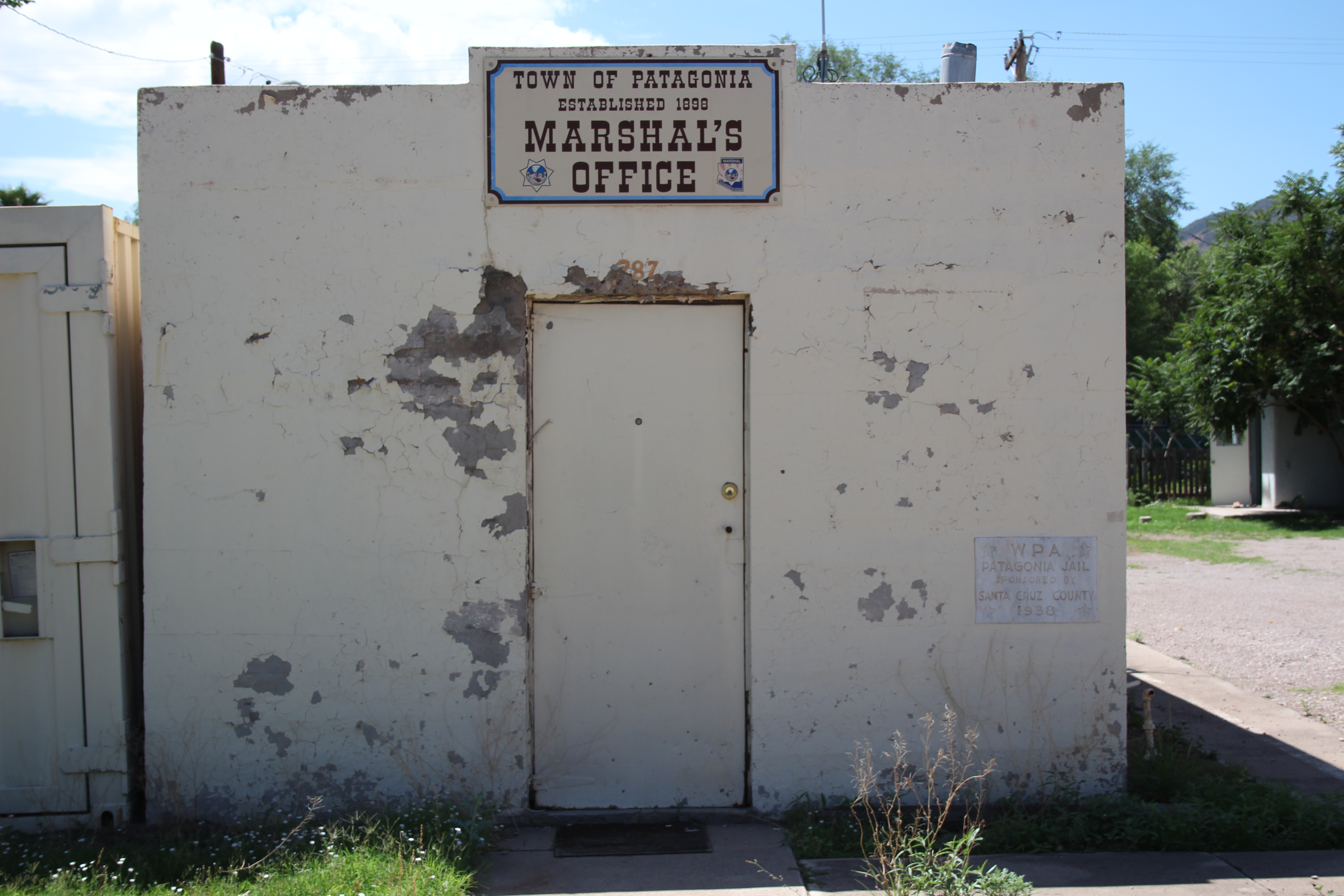
 Subtly funky Patagonia, situated between Nogales and Sonoita on southern Arizona's Highway 82, might just be my new favorite little Arizona town, the epitome of adorable. With a history tracing back to Jesuit Father Eusebio Kino's forays into the region in the 1500s, parts of the town reflect the Spanish influence. The train depot, though, is pure turn-of-the-century western, while the small, square, concrete Marshall's Office and jail are 1920s WPA (Works Progress Administration). Other structures hearken back to 1950s road-trip culture, and the Velvet Elvis Pizza Shop adds just-enough-modern-funk to be charming and yet not so much to be ruined by its own preciousness. Open roads in each direction are rich with pre-territorial and territorial-era military history and are pure joy to drive for the varied open terrain. Even on this mid-July Arizona day, when Phoenix-area temperatures rose to 114, at 4050 foot elevation, Patagonia was ideal - the kind of day you'd say, "Yeah, let's sit outside for a while," and enjoy the green hillside views brought to you courtesy of this year's monsoon.


The town's name derives from the Spanish and means "big foot." Some early sources said it was so called for the distinctively big feet of local Indians. The town itself was named after the nearby Patagonia Mountains, which were named after the Patagonia Mine, which had been so-named in 1859 by Lt. Sylvester Mowry, who purchased the mine from a Mexican. The naming origin gets more confusing, though: Originally, Patagonia indicated the post office founded in 1866 at the Mowry Mine, ten miles to the south; the first postmaster at that location was Lt. Mowry's brother, Charles. 

A Pennsylvanian and Civil War veteran by name of Rollen Rice Richardson, made wealthy by eastern oil money, bought large ranch holdings in the region, including Monkey Springs Ranch and the abandoned Camp Crittenden. By 1890, Richardson and his two partners had a vast cattle enterprise but the drought devastated the enterprise. Richardson sold out everything but 500 acres which included the site of today's town of Patagonia. Richardson moved the town of Crittenden, residents and all, to the site in 1896. Sadly for Richardson's legacy, the townspeople refused to support his quest to name the town (via name of the post office) Rollen, but in a turn of good luck for lovers of appealing and interesting names, they chose the name Patagonia for their new town, co-opting the name from the previous post office at the mine. The post office at the current Patagonia was established in 1900 under the oversight of postmistress Mamie M. Cretin.


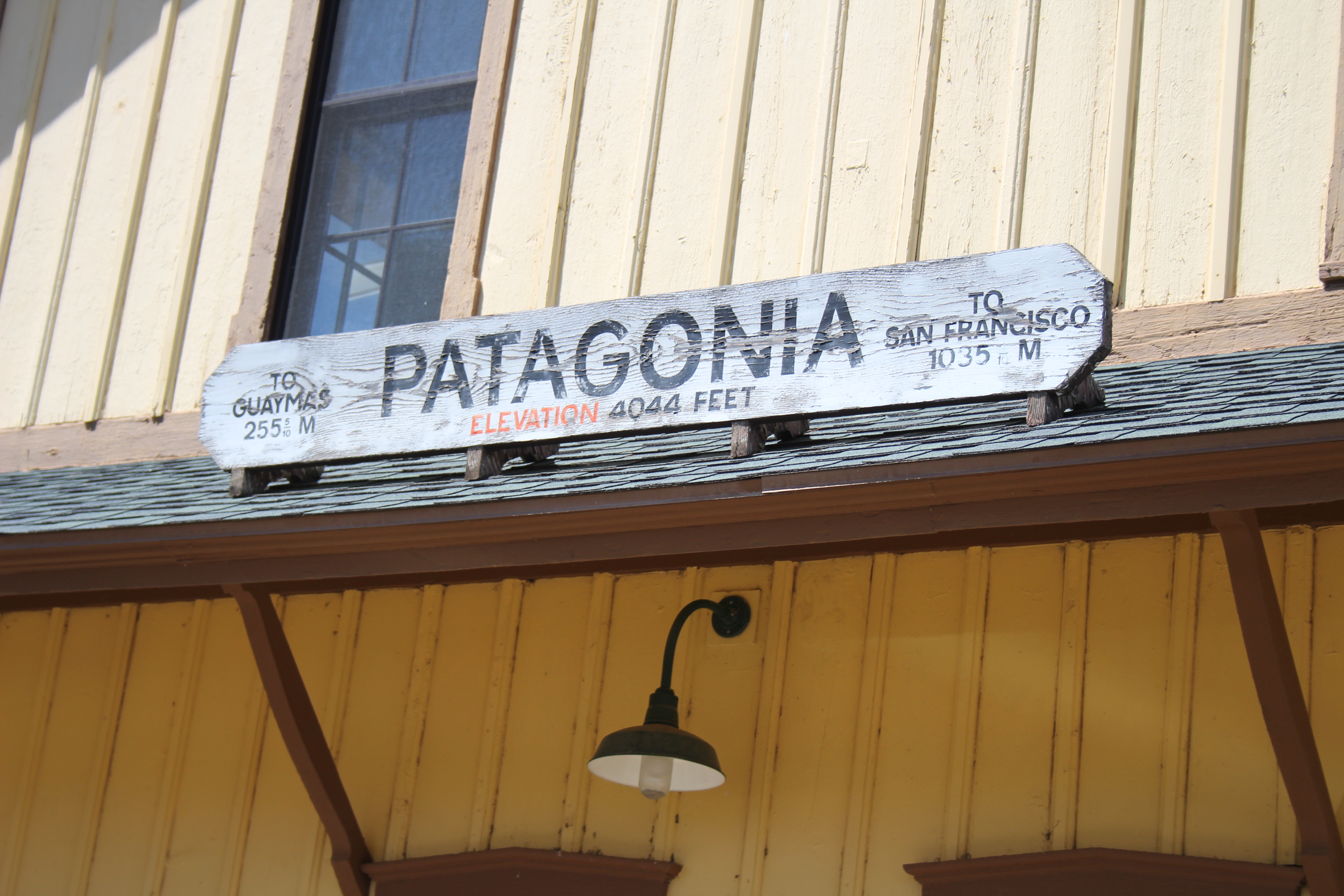
The mine itself had been a rich source of silver and lead deposits, and Lt. Mowry himself - recently retired from the U.S. Army - was accused by the military of using the mine's lead to make bullets, which he sold to the Confederacy. Lt. Mowry was arrested, charged with treason, and held at Fort Yuma, and the mine confiscated by the Army. Lt. Mowry was never court-martialed and later sued the federal government and culpable army staffers in vain. The marker above is in front of the train station at Patagonia.


The train station, built in 1900, stood along the now-abandoned tracks that were built in the 1880s to connect Nogales to Benson. The peak of the railroad's use came during World War II, when thousands of tons of ore were shipped out of the area's mines each month to support the war effort. As the mines shut down, a preservation-minded citizen, recognizing the significance of the train depot, purchased it.


By the 1930s, the Mowry Mine townsite was a ghost town, but the Works Progress Administration brought some work to the area: the small town jail above was built by WPA crews. The WPA also hired authors to chronicle America and its history; their volume on 1930s Arizona included visits to Patagonia and neighboring areas. 


At the time of the WPA writers' visit, the town boasted 500 residents, considerably more than the 133 who occupied the town when the train station was built. Throughout these decades, the community's Methodist Church, shown below, served the faithful. Built around 1923 by local residents, the elegant stained glass windows were added by local artist Jean Burger in the late 1980s throughout the 1990s. According to the plaque to the left of the door, the window shown here is called "Cross Window and White Rose" and employs the "Tiffany method of stained glass art." 


Across the main road of town, look for the wonderful PIGS station below, a throwback to rural stations of mid-century roadtrips. What's not to love about Patagonia? Even at today's record-high gas prices, a roadtrip to Patagonia - and while you're at it, nearby Sonoita and Elgin - is worth the time and money. If you're from the Phoenix or Tucson metro area, you'll feel like you're in an entirely different state - and no matter where you're from, you'll feel like you're a time traveler visiting an entirely different era.  


Copyright (c) 2022 Marcy J. Miller * All rights reserved * No part of this content, including photographs, may be used without the express permission of the author * Links and shares, however, may be freely shared and are appreciated. All photographs by Marcy J. Miller.

Partial list of sources: 

Will C. Barnes, Arizona Place Names, 1960 edition
The WPA Guide to 1930s Arizona
John and Lillian Theobald, Arizona Territory Post Offices and Postmasters, 1961
Ray Brandes, Frontier Military Posts of Arizona, 1960
Arizona Highways Magazine
On-site placards and historical markers


Friday, July 8, 2022

The Site of the Bisbee Massacre, the Lynching of John Heath, and the Grim End of the Cochise County Cowboys

 As a child, already enthralled by Arizona's history and constantly poring over my Dad's library of books on the subject, I was simultaneously mesmerized and intrigued by a grim photograph of a blindfolded man dangling by the neck from the crossbar of a pole, a dapperly-dressed crowd gathered beneath his feet. His name, John Heath - whatever book I'd first seen the photo in had "John Heith" in the caption - stuck with me. I later learned the backstory of the photo, and over the years I revisited the photo many times in many different sources, first in the brittle pages of fly-jacketed volumes of local history, then online. This morning I visited the site where the photo was taken.


On the southeast corner of Toughnut and 2nd Street in Tombstone, just slightly off the tourist-beaten path to the east, is a historical placard. It stands on the edge of a neatly-kept property with a small, charming picket-fenced cottage, the famous Tombstone Courthouse looming in the background. 


What's most interesting in the larger photo above is the stump of a pole to the left of the placard. That is the stump of the telegraph pole from which Heath was hanged by the angry mob. 

The crime for which Heath had been lynched was shocking to the people of A.T. (Arizona Territory) despite the frequency of violent crimes in the region. Later dubbed "the Bisbee Massacre," it was a robbery-gone-bad. Hoping to rob the Goldwater and Castaneda Mercantile of the payroll for the Copper Queen Mine, members of the Cochise County Cowboys gang tied up their horses down the street to the east, near the smelter for the Copper Queen Mine. They entered the general store only to find the payroll hadn't arrived yet. They did, however, take what was available as well as rob everyone in the store at the moment. They made off with perhaps as much as $3,000 dollars plus watches and jewelry. Citizens nearby recognized a robbery in progress and intervened. The shootings commenced. The first man shot was J. C. Tappenier, an assayer for the mine. Next, a San Pedro rancher and Deputy Sheriff, C. Tom Smith, having dinner across the street, confronted them, allegedly identifying himself as a peace officer. Members of the gang quickly felled him with a shot to the head. They shot lumberman J. A. "Tex" Nolly in the chest, and shot the pregnant proprietor of a boarding house, Mrs. Annie Roberts, who'd come out to see what was going on. The bullet penetrated her spine and later proved lethal. Another man was struck in the leg by a wayward bullet and injured while fleeing, but did not die.


Here - at 26 Main Street, Bisbee - is the Letson Loft Hotel, which now occupies the building that once housed the Goldwater & Castaneda Store, where the Bisbee Massacre occurred. (c) 2022 Marcy J. Miller 


This view, with the former Goldwater & Castaneda Store on the extreme left edge, shows a street view in the direction of where the horses would have been tied. Bisbee's narrow streets didn't accommodate buckboards and horses tied in front of businesses, making a quick getaway difficult. (c) 2022 Marcy J. Miller


Outrage over the brutal, senseless crimes was immediate. Posses quickly assembled and pursued the members of the gang. The first posse, headed by Cochise County Deputy Sheriff William "Billy" Daniels, left Bisbee immediately in pursuit. That posse included none other than John Heath, who'd been deputized for the purpose of pursuing the robbers. 

Meanwhile, the culpable cowboy gang assembled to the north at Soldier's Hole, a historic site east of the Dragoon Mountains and between Gleeson and Elfrida, where they split their haul and then split up. Once serving as a stop on the Butterfield Overland Stage route - among other utilitarian purposes - Soldier's Hole (alternately known as Soldier Holes, Soldier's Holes, and Descanso)  is an unremarkable flat patch of land now commemorated by a historical marker. The robbers gathered there included Omer "Tex" Howard, Red Sample, Daniel "York" Kelly, Daniel "Big Dan" Dowd, and William E. "Billy" Delaney. John Heath knew them from a spread in the Sulphur Springs Valley known as the Buckles Ranch, and once Deputy Daniels was able to identify Tex Howard, suspicion soon fell on John Heath in a clear case of guilt by association. The men were rounded up in various corners of the region: Tex and Red were found north of Clifton; Big Dan and Billy were found across the border in Sonora; and York made it as far east as Deming. 

The men were reunited in Tombstone. After a three-day trial presided over by Judge Daniel Pinney, five of the men - Tex Howard, Red Sample, York Kelly, Big Dan Down, and Billy Delaney were found guilty on February 18, 1884, and sentenced to be hanged until dead. Four of them had been identified by eyewitnesses at the scene of the crime or during their flight immediately afterwards. John Heath, however, was tried separately. No eyewitness tied him to the crime, but a cavalry soldier who'd been locked up with the men testified he'd heard the gang - Heath included - discussing their aborted attempt at robbery. Based on his testimony, Heath was convicted of second-degree murder and sentenced to life at the notorious Yuma Territorial Prison. (The soldier who testified against him, likely in exchange for his testimony, received a lenient sentence at Yuma for the murder he had committed.)


The stately Cochise County Courthouse in Tombstone, Arizona, where the Cochise County Cowboys were tried and convicted for the Bisbee Massacre. (c) Marcy J. Miller


Frontier justice intervened. While the five men who'd been sentenced to death lived on for another m month in jail, awaiting their execution, on February 22, 1884, Heath was busted out of jail by an armed lynch mob and cruelly, slowly strangled to death, drawn up by manually by the neck via the rope slung over the telegraph pole. Guilty, if at all, of nothing more than participating in planning the crime and perhaps attempting to misdirect the posse as the others fled, he faced the cruelest death of all the men. On March 28, 1884, his compadres were professionally hanged on a specially-built gallows behind the Tombstone Courthouse, and all but Big Dan Dowd died promptly when the gallows door dropped. The drop wasn't adequate for Big Dan, though, and he strangled just as Heath had. 

A thousand people were in attendance for the grim display, many of whom paid $1.50 each for a seat in a specially-constructed grandstand. The bodies hung for about half an hour before being cut down and removed to the mortuary for examination; all but Omer "Red" Sample died of strangulation. He, being more fortunate than the others, incurred a dislocated neck during the hanging. The bodies were given a Christian burial at nearby Boot Hill Cemetery where, just as during the execution, visitors continue to find them a source of entertainment. John Heath's body, initially interred there as well, was later relocated to his home state, but a less-reverential resurfacing was spared his partners in crime. The "Angel of the Mining Camps," famed and kind-hearted Tombstonian Nellie Cashman, prevented the condemned mens' bodies from being dug up and used for medical research. She arranged for local miners to guard the graves for ten days and prevent exhumation. It was Nellie, too, who was horrified by the spectacle that attended the mens' execution, and arranged for the destruction of a viewing platform for the audience. 

All the men proclaimed their innocence to the end, claiming they were judged wrongly based on their own reputations, but unlike Nellie Cashman they were no angels. Billy Delaney's own frequent proximity to newly-dead corpses gives a glimpse into his character; on the day of his execution, he spoke with reporters. Billy, apparently much-misunderstood throughout life, said he was born on July 11, 1856, in Scranton, Pennsylvania, and later "was supposed to have left Harrisburg under suspicion of a murder, of which I am innocent." He went on to say he'd lived in Arizona Territory for four years as a miner and prospector and was indicted in Graham County for shooting a man through the heart after the man intervened in an argument between Billy and a Mexican woman, but - Billy averred - "I am entirely innocent of this crime," and stated he was misjudged based on his own reputation.  The Arizona Daily Star described him as a "short, well-built man about five feet four inches in height; he has clear, intelligent eyes, black hair, a well-developed forehead, and expresses himself in a gentlemanly language." 

Twenty-four year old Missouri-born Omer "Red" Sample also avowed his innocence on the gallows, saying "I am to be hung for a crime I never committed." The paper described him as a "splendid specimen of physical manhood," and 6'1" in height, already suffering from a gunshot wound in his side and "of a brutal countenance." The writer described Daniel Kelly as 25 years old, with a very dark complexion, 5'6" tall; Tex Howard was 24, born in Texas, and with an intelligent, manly face - and real name unknown. Daniel Dowd was 27, 180 pounds, and had come to Arizona four years previously. He, Howard, and Delaney echoed Red Sample's proclamation of innocence in the moments before Kelly said, "Let her loose!" and the gallows trap was sprung. 

Shortly after the crime had occurred, and while the gang was still on the run, another paper, the Weekly Republican, via the Benson Herald) provided physical descriptions of the men as well. Red Sample - called "Big Red" in that edition - had light hair, very red complexion, and a badly crippled right hand from partially-healed gun shot wounds, with part of his thumb shot off. Big Red had a distinctly receding chin and round shoulders. Dan Kelly was "splendidly built" and had a thin mustache, while Tex Howard - called simply "Tex" in this article - was a well-built 5'11, 160, with light brown hair and a light complexion. Mis-understood Delaney had a mustache, too.

As for ill-fated John Heath's physical countenance, he was described as 5'6", 150, with a dark complexion, very black hair, and very dark mustache - and a glass eye on the right side. 


The tidy cottage now standing on the corner where John Heath was lynched. The telegraph pole from which he hanged is to the right side of the picket fence on the right edge of the lot. This view faces south. (c) Marcy J. Miller


(c) 2022 Marcy J. Miller * All rights reserved * No part of this content may be reproduced, including photos, without the express permission of the author * Links to this page may be freely shared and are appreciated! Thank you for stopping by.


Monday, January 17, 2022

Cochise County's Spanish Fort: Presidio Santa Cruz de Terrenate


View to the Northwest from the Site of the Presidio, Showing Former Location of the Railroad Tracks


On the banks of the San Pedro River, a couple of miles north of the ghost town of Fairbank, Arizona, stand a few remnants of adobe walls. Their edges rounded and smoothed by over two hundred years of wind and rain, they bear little resemblance to the grand Spanish fort they were once intended to be. The beautiful land around them remains unpopulated and, for the most part, pristine. Pristine, that is, but for the ballast of what was once the railroad line that carried ore from the area's mines, some debris left by more recent visitors, and the tastefully-few signs and trails leading to the site of the old adobe ruins.
This site was once the Presidio Santa Cruz de Terrenate. Here, in the late 1700s, the Spanish military erected one of several forts - presidios - to serve as a system of defense against the native people, the Apache. In the typically cosmopolitan manner of the region, it was an Irish mercenary, Hugh O'Conor, who founded the fort in 1775 on behalf of the Spanish crown. The endeavor was hardly a success. The predations of the Apache were too persistent and deadly for the Spanish troops and by 1781, they admitted defeat and abandoned the still-incomplete presidio. 

Named Terranate - Spanish for "land the color of masa (corn flour)" for the pale yellowish color of the earth - the presidio appears as one of ten Spanish fortifications on the 1777 Spanish map of the region, a portion of which is below:


Note the settlement called "Tuqulson" to the upper left of Terrenate. That is now the present-day city of Tucson; directly beneath it is "S. Xavier," - the Mission San Xavier del Bac, founded in 1692 by Padre Eusebio Kino. The Spaniards had maintained at least a nominal control of the territory since beginning their explorations in 1540. Although the area boasted abundant silver and gold, the Spanish were unable to effectively exploit the rich minerals due to the Apache attacks. From direct assaults on the troops to a campaign of stealing the Spaniards' horses or raiding the mule trains bringing much-needed supplies, the Apache made the forts impossible to defend. 

The presidio at Terrenate was laid out with a main entry facing the San Pedro River and staffed by 56 men. Thick adobe walls were built to surround the fort, and within it, the hopeful settlers would plant crops and build a chapel, barracks, and commander's quarters. Early in the effort, on July 7, 1776, a raid on the fort resulted in the death of 30 men, including the commander, Francisco Tovar, himself. He was replaced by Captain Francisco Ignacio de Trespalacios, who'd arrived with reinforcements and additional supplies in August. The new captain lasted until the summer of 1778, when he and 19 others were killed in another assault on the presidio. His replacement, Lieutenant Colonel Pedro Fages, would be the final commander. As the fort's supply of horses - originally over 350 - dwindled to under 100, and troops were diminished to just 46 soldiers, the decision to abandon the fort was made by Inspector Roque de Medina. The location was too difficult to defend and too remote to be reliably provisioned. By 1780, the remaining men were relocated. 

The Apache, meanwhile, used the plunder from the raids to facilitate their own raids on enemy tribes. From wearing the helmets and leather jackets of the soldiers they slaughtered to riding the Spanish horses, they employed the muskets and pistols of the fallen as well. 


Remains of the Chapel Walls


Today, all that remains of the ill-fated presidio are portions of the walls of the chapel, commander's home, barracks, and front entry. Mounds of what had been adobe bricks dot the fort's footprint. Signs are present along the interpretive trail offering a brief history and identification of the ruins. 


The Ruins of the Commandant's Quarters

Should you wish to visit the ruins of the presidio, access Highway 82 from Highway 80 (the road between St. David and Tombstone). Go west until you reach N. Kellar Road; turn right (north) and proceed until you see the parking lot / trailhead to the presidio on your right. The trail to the ruins is 1.2 miles of mostly flat and easily navigated terrain, but note that when you reach the railroad ballast (the foundation the tracks once sat upon), follow it to the right / east. On my recent visit there was no directional sign at the ballast. There is no water, shade, or other amenities, so be sure to dress appropriately, take water, and wear appropriate clothing. This means a hat to provide sun protection and proper shoes / boots that can handle the prickly things that the desert is famous for. In warmer weather (and it's usually warmer), snakes may be present. Respect the historic significance of the site and don't be the idiot who leaves this on the railroad ballast along the way: 


While you're in the area, be sure to visit the nearby ghost town of Fairbank. More on that coming soon.


(c) 2022 Marcy J. Miller * All rights reserved * No part of this content, including photographs, may be reproduced without the express permission of the author * Links, however, may be freely shared and are appreciated * Thank you for visiting!


Monday, February 17, 2020

An Arizona Visionary and a Long-Forgotten Town: Marshall Shelton and Acre City


Sleepy, dusty Phoenix had not even 25,000 residents by 1916, but had more than its share of visionaries who saw a chance to make a better life or better world. From those who found ways to bring water to the desert to those who built resorts to help "lungers" (tuberculosis sufferers), people who dreamed of making a difference found fertile ground in the arid earth of the Salt River Valley. Some live on in our daily lives by leaving their names on streets, dams, mountains, or hospital wings; others never achieved their dreams at all. Many, if not most, occupied that middle ground between the magic and the tragic, where they achieved some success but ultimately watched their castles crumble.

Marshall Shelton's name is unfamiliar to most Arizonans. On some online maps, it appears as a neighborhood name tagging part of the area between Van Buren and Washington, from 30th Street to 34th Street. Adjacent to the "Shelton" area is an area labeled "Acre City," and below that, between Air Lane and Madison, is "Pacific Place," and to the east is "Portland." These Monopoly-game names are all connected, historically as well as geographically, in a unique tale of a man who dreamed of giving a small, disenfranchised population their own exclusive community to follow their own dreams.

Marshall H. Shelton arrived in Arizona a couple of years before it achieved statehood, accompanied by his Tennessee-born wife, Genevra, and their two adopted sons, Charles and James. Born in Missouri on April 2, 1870 (or the 21st, or March, 1873, depending on which official records you choose to believe are correct), Shelton had come most recently from Seattle, but had lived in plenty of other states before making his way to the southwest. As a young adult he worked for several years as a porter at various places in Kansas City, including The Tuxedo Club (1898). By 1900, still in Kansas City, he'd married his wife, Genevra Williams, to whom he'd remain married until her death. They moved to Seattle by 1910, and Marshall worked as a solicitor. 5'10" and a slim man, Marshall was ambitious and hard-working.

Soon the couple found themselves in Arizona, settling near Washington Street in what was then the fringe of Phoenix, an area verdant with alfalfa crops and citrus groves. Marshall, by then a real estate broker, conceived of a lofty plan. He established an office at 215 W. Washington and from there he began marketing the opportunity of a lifetime: Giving people who were otherwise not likely to be able to buy real estate a chance to buy their own acreage in his planned community, which he called Acre City. By May, 1914, Shelton was advertising lots at $350 an acre, some of which were already planted in alfalfa. He promised the area would soon grow into a thriving town of industry, with a general store coming to the corner of National Avenue and Division Street. Shelton encouraged those who dreamed of raising chickens or cattle to buy in his new town, even offering to help them get a cow if they didn't have one.

Shelton laid out the streets of his new town with attention to every detail. He named one street, Genevra Court, after his wife; others were given women's names such as Leola, Zelda, Edna, Maria, and Elvira. The street he called Genevra (sometimes appearing as Genevie in newspaper articles) is now Madison Street, and the National Highway he proudly raved about is what is now Van Buren. At the time, the area he developed - Washington to Van Buren between 32nd Street and towards 44th - was in between the cities of Phoenix and Tempe, and Shelton saw it as an "intermediary" town.

The Arizona Republic carried frequent mention of Acre City in its section devoted to local news from around the state. A woman named Hope Edson was Acre City's designated correspondent. Her columns were filled with optimism for the emerging community as she informed readers of critical events. Mr. George Cagle planted fruit, pecan, and shade trees on the George Utley property, she wrote; her husband, P. J. Edson, harvested a crop of pears for Mr. Carr.  She told us when Mrs. Carson had left for the mountains to partake in the bracing air up north, and when Mr. Cotton and his son, Fred, were in the mountains for Mr. Cotton's recuperation from an unspecified illness. Ella Stevenson bought an acre to raise chickens on, and Mr. McNeff bought the property north of F. R. Towar on Genevie Court. As for Marshall Shelton himself, Hope Edson boasted that Marshall had a flock of 80 colorful ducks.

So the town grew. Five houses popped up on Division Avenue. Mrs. T. V. Parsons, from Fresno, purchased five acres in the Zeibenow addition nearby. By fall of 1914, acres were going for $525 apiece. The next year, the Cauthen family moved to an orange grove north of the Desert Inn, and Belle Grissinger, a farmer's daughter, made plans to convert her seven-room house into apartments. Roberts Willabos visited his brother Louis, and Mrs. Carson built a chicken coop. Babies were popping up all over: by March, 1916, Acre City boasted no fewer than a dozen infants and toddlers under the age of three years. Children had become so abundant that the city had an active boys club that promoted reading, writing, recitations, and cornet playing. Residents circulated a petition in an effort to bring a primary school to town, as the National Highway had become so heavily trafficked that it was unsafe for the little ones to walk to school. 

A big event happened in January, 1919: Mr. and Mrs. R. A. Waschan had twins. Hope Edson referred to them as the "famous" twins, and the newspapers carried the news that the Waschans were going to name the babies with the public's help. Ruby Bowers and Mabel Weaver submitted the winning names: Milton and Marie.

Meanwhile, Marshall and Genevra themselves had added two boys to their family. There's a  mystery involving the boys, though - their origin, and whether or not they were actually their biological sons or not. One census record specifies the boys are adopted, but there are reasons to doubt this assertion. You see, the reason Marshall and Genevra Shelton began master-planning a community was that they wanted people like themselves to have an opportunity to own land. In a time when banks generally denied mortgages to black people, Marshall and Genevra - designated "Neg," for "Negro" on census records, or with a "C" for "colored" on voter's rolls - were themselves a black couple who saw a chance to create an exclusive community where blacks were able to buy property and achieve the dream of home ownership and cottage industry. By 1920, only about 4% of the population of Phoenix was black. Perhaps it was because, compared to most states, Arizona's was relatively hospitable to blacks drew the Sheltons to the valley. Already Phoenix had a black newspaper, the Phoenix Tribune, devoted to civil rights issues and local black news. The well-established Arizona Republic praised the paper and its publishers, and encouraged readers to subscribe to the Tribune, in addition to promoting the news and marketing of Acre City. News of the settlement spread and even the nationally-known black educator, Hattie Q. Brown, bought land from Shelton for her winter home. Whatever the reason, the ever itinerant Sheltons stayed in Arizona for the remainder of both their lives.

Here's the mystery regarding the Shelton boys. Charles Courtney Shelton was born in 1921 in Denver, Colorado. His brother, James Curtis Shelton, was born March 8, 1925, in Portland, Oregon. In the 1930 census, Charles and James are listed as adopted, and their race is designated as white. In the 1940 census, the boys were not cited as adoptees, and their race has been designated "Neg" for "Negro." Shortly after that census, the young men went to war. On their draft cards and subsequent military records, they're both designated as white. I assume that, whether or not the sons were in fact adopted or were the biological sons of Marshall and Genevra, that they were light-skinned enough to "pass" and that their parents made the decision to identify them as adopted white children to offer more opportunities to the young men. I could find no birth records or newspaper accounts of their births, but that isn't in itself unusual. On James' 1942 draft card, his description is given as 142 lbs., 5'8", with brown hair and brown eyes and a "sallow" complexion. I could find no photographs of them - yet - but I did find yearbook photos of Charles' two sons, Curtis James and Bruce Eugene, and they each have features that appear consistent with some African descent. Clearly I do not know with any certainty the facts of James' and Charles' birth or ancestry, nor the motivations for the family changing their racial identity to "white" on documents, but based on that being a not infrequent occurrence in those years, and the understandable inclination to want their sons to be as free as possible of bias and closed doors, it makes sense to me.

Marshall's two sons, as mentioned, went off to fight in World War II. Private Charles Courtney Shelton, service #18017448, served in the 60th Coast Artillery Corps., I Battery Anti-Aircraft, in the Southwest Pacific Theatre: Philippines. In 1943, he was taken prisoner by the Japanese and detained at Hoten POW Camp (Mukden) in Manchuria. Pvt. Shelton was liberated on May 7, 1942. He suffered greatly during his detention and became disabled. Upon his return, Pvt. Shelton lived only until April 9, 1949. He left behind his widow, Alice, who briefly stayed in Phoenix with the two small children. In March, 1951, Alice accidentally backed her car over two-year-old Bruce in the driveway of her home at 9101 N. 12th St. in Sunnyslope, breaking his leg. Not long thereafter, she took the boys to Springfield, Missouri, and raised them there. Both eventually returned to Arizona after graduation from high school.

The younger brother, Bruce Eugene Shelton, was born on December 7, 1948, seven years to the day after the attack on Pearl Harbor. He attended Phoenix College and ASU. Like his father, he went off to war and served in Vietnam in the First Cavalry 11th. Bruce died on September 7, 2012 and is buried at the National Memorial Cemetery on Cave Creek Road in Phoenix. Bruce's older brother, named Curtis James Shelton in tribute to his uncle, was born June 1, 1947, also went to Vietnam. On November 28, 1967, he was wounded in the war. Curtis survived and returned to Tucson, Arizona, where he died on March 15, 2003.

The uncle Curtis was named in memory of, Marshall Shelton's younger son James Curtis Shelton, (born March 8, 1925) enlisted in the 1402 Army Air Force on June 15, 1943. On March 31, 1945, he was killed in action. James' body was brought home to be buried at Tempe Cemetery, not far from Acre City. On February 3, 1949, Marshall Shelton applied for his son's grave marker. His address at the time was 33 North 11th Street, Phoenix, still near the place he'd built a city in the desert.

By then, Genevra Shelton had died. Born on February 1, 1875, in Nashville, Tennessee, to James Williams and Julia, Genevra was a petite 5-foot-tall, 100-pound woman on her voter registration in 1928. (Both she and Marshall were registered Republicans.) Genevra, despite her birth as a woman of color in the 1800s in a southern state, was literate. She and Marshall formed a business with a partner from Los Angeles. They were both founding officers of the Phoenix and Los Angeles Investment Association formed on April 18, 1928. 

During this chapter of the Sheltons' life - the 1920s - the were hard at work on developing acreage known as "The Portland Tract" into another exclusive community for black Arizonans. By 1923, Shelton advertised that the land was near a meat packing plant and that a cement plant would be built as well, offering more opportunities for industrious-minded people. The Portland Tract was bordered by Van Buren on the north; "Four Mile Road" on the west (now the 40th Street alignment) and "Chicago Avenue" on the east (now 44th Street) and the northern edge of what is now the Sky Harbor Airport grounds. Shelton, acting as agent for his Los Angeles partner Edward L. Minsoh, requested the platting of the tract for his new city. That tract was the NW 1/4 of Section 7, TWP 1N, Range 4E. 

The Portland Tract - which it appears was to be called "Pacific City" - remained mostly undeveloped into the 1930s. It is likely the Great Depression halted Shelton's progress. In 1941, Sky Harbor (nicknamed "The Farm" because of its location in rural farmland of the valley) began rapidly expanding. Much of the Portland Tract was consumed by the airport. It was noted to have been occupied primarily by squatters in cars and tents by then [FAA Sky Harbor Environmental Impact Statement, June, 2005]. Once - in the 1890s - owned by livery stable owner Joseph S. Drew, the land then became a failed city for people of color, and was now to be part of an airport that would one day grow to be the busiest in the nation. 

His dreams halted by the economy, Shelton stayed in the area throughout the 30s and 40s. At 11:40 a.m. on November 29, 1946, at age 71, his long-time wife and partner, Genevra, died of colon cancer in Tempe Hospital after a two-month stay. I could find no obituary nor newspaper tribute to Genevra. Her name on her death certificate was spelled "Genevera"; at times in census records and other documents, it appeared as Genevie. Searches under all such spellings turned up nothing to honor her death. Soon, Shelton would be alone in Arizona, his grandchildren having moved to Missouri; his sons both dead; and his wife gone. On June 16, 1952, Shelton died at his home at 311 N. 32nd Street. Maricopa County Sheriff's deputies served to provide information to the medical examiner regarding his death, as no family was left to do so. He was in his 80s when hypertension-caused heart failure felled him. Shelton is buried in Tempe at the Double Butte Cemetery, near the land he'd believed in. I could find not a mention of his passing in the papers. 

Nothing discernible remains of Acre City, Pacific City, or the Portland Tract except asphalt, dusty weed-filled lots, and a mention on online maps. A few businesses - Circle K, a car lot, and so forth - have been built, and a few aged homes cling to the neighborhood behind chain-link fencing. Planes taxi down runways where Portland Tract once promised to be the promised land. Even the street names have changed; there's no Shelton Road, nor is Genevra still commemorated on street signs. But once, that area was an exciting, thriving community, all because of Marshall Shelton's ambition and vision. 


For anyone researching Acre City or its original inhabitants for genealogical purposes, here are a few of the additional names I ran across. Spellings of names are suspect, so don't accept them as accurate; many were gleaned from Hope Edson's newspaper column about Acre City happenings. I cross-checked many names in census records and other official documents, but interestingly, found very few of the people below were designated as black in those records.

Bates: Little Gordon Bates was ill as of January, 1916, but improving.
Carr: Owned a pear tree orchard
Carson
Nellie Cassity: Lived in Colorado, but attended school in Acre City.
Cotton
Couthen (lived on the Dr. Bond property until moving to an orange grove north of the Desert Inn).
Donaway: Mrs. Donaway lived in Acre City until moving to Phoenix.
Hope Towar Edson: Born in 1901 in Iowa, daughter of P. J. Edson
Gareison / Garelson: "A resident of Acre City for some time" moved to Phoenix in September, 1915, to open a business there.
Emmanuel Gormezis: In 1916, erected a large chicken yard on the Jack verner property just west of Belle Grissinger's house.
Cathuleen Kendall lived in Acre City until September, 1915, when she left for Tempe to attend the Tempe Normal School (now ASU).
Lasem: lived in Acre City in October, 1915.
Lasuer: Mr. Lasuer worked at a quarry near Tempe.
McNeff: owned the property north of the F. R. Toward place on Genevie Court.
Pare: Mrs. Pare was ill in January of 1916 and was attended by Dr. Dameron.
Robert Parscal: The Parscal family owned a ranch and alfalfa fields in Tucson. Robert Parscal was a resident of Acre City in January, 1916 and, at the time, suffered a serious illness.
Ella Stevenson bought one acre in Acre City.
Mr. and Mrs. R. A. Waschan had the twins, Milton and Marie.
Robert Willabos


Residents of Genevra Court (Del Rey Precinct) as of 1930:

Charles and Thelma Norton (white)
Charles M. and Ethel M. Norton (white)
Mary Fraley (white)
Thomas and Frances Brown (white)
Bradbury Thomson (white) 
Silvio Sinforiani (white, Italian immigrant)
Matthew Mitchell (black - listed as "Negro" in census records)

In 1930, the Shelton family lived at 305 Orange Road, one of the north / south streets in Acre City / Portland Tract.

Credit for the inspiration for this content goes to Twitter friend @UncleTom2019, with my thanks for introducing me to such an interesting and little-known piece of Arizona history.


Copyright (c) 2020 by Marcy J. Miller * All rights reserved * No part of this content may be reproduced without the express permission of the author * Links, however, may be freely shared and are appreciated * Thank you for stopping by!


Tuesday, November 5, 2019

Arizona's Official Anthem, 1901

On March 16, 1901, by way of Act No. 49, the Arizona Territorial legislature adopted an official anthem of the Territory of Arizona. Here, faithfully transcribed in all its sun-kissed glory, are the lyrics.

HAIL TO ARIZONA, THE SUN-KISSED LAND.

O, Arizona, Sun-kissed Land; 
Thy day of birth is near at hand;
Upon they mountains' rugged crest,
They native sons still call thee blest;
Within thy valleys' broad domain,
In love, thy foster children reign;
Fair Land of gold and sunny peace,
Of flower and vine and rich increase,
Of cloud-kissed hills and wooded wold,
Of countless mines and wealth untold.

CHORUS.

Hail: all hail to Arizona:
Sound her praise from sea to sea:
Land of sun and summer showers,
Land of grain and gold and flowers,
In Columbia's diadem
Of jewels rare thou'lt be the gem,
Hail to Arizona, the Sun-kissed Land.

Primeval stands thy forest grand,
The ancient Zuni's fatherland,
The plain and lofty mountain round,
Were many moons his hunting ground,
Unbosomed in thy sun's bright ray
His olden ruins slow decay;
Where once the tribes of Ishamel's band
Marauding wandered o'er the land,
The mighty "Phoenix" rose to fame
From the ashes of destruction's flame.
(Chorus.)

Hoary with age, thou still art young,
Land of renown with praise unsung;
Nature with a master hand
Hath carved thy wondrous Canyon Grand;
Magician-like her wand she plied,
And lo: thy Forest Petrified;
From craggy peak of Castle Dome,
From Copper Queen to rich Jerome,
She pours her lavish treasure forth
In molten streams of priceless worth.
(Chorus.)

Not all thy riches, glorious Land,
Are due alone to Nature's hand,
For man with unremitting toil
Brings forth a bounty from the soil;
From vine-clad hills and limpid streams,
From fruitful vales where plenty teems,
O'er verdant fields he points with pride,
Where flocks and herd are scattered wide,
To schools where art and skill combine,
To homes in love and truth enshrined.
(Chorus.)

Proud Land, thy rock-ribbed hills record
The history of a mighty horde;
The onward tread of centuries old
Hath left its imprint strong and bold
On the hearts and lives of thy brave sons,
In the winsome grace of thy fairer ones;
Thy Rider's Rough, a valiant band,
With loyal hearts forever stand
To guard the flag that floats above
Thy homes where reign content and love.
(Chorus.)

(End anthem.)

The statue passing the adoption of the above anthem also mandated that trustees of the school districts were to furnish copies to all schools to allow Arizona's students to learn and perform the song "as part of the musical exercises of their schools."  

The "day of birth" mentioned in the first stanza refers, of course, to the optimism towards approaching statehood. Due to the "Indian troubles," statehood wasn't granted until several years later in 1912. 

Note that the final verse pays homage to the Rough Riders, of which Buckey O'Neill was a member. In the same legislative session, it was also enacted that the Roosevelt Rough Riders Association would be permitted to commemorate the Arizona contingent of the First United States Volunteer Cavalry - better known as the Rough Riders - with a medallion, inscribed with the names of all the Rough Riders who perished in the Spanish-American War, in the rotunda of the Territorial capitol building. 

Monday, June 24, 2019

A Whistle-Post on the Railway: Arntz, Arizona

Follow the railroad tracks best of Holbrook, and just a few miles outside of town you'll pass a bare patch of land where a railroad station once stood. You'll know you're there because the Arntz Road crosses the tracks there from the north before veering sharply east. The station took its name from Werner Peter Arntz, the railroad roadmaster for the Atchison, Topeka, and Santa Fe Railroad. Arntz may never have even lived in the settlement that took his name. In June, 1921, Arntz succeeded H. C. Storey as the train master on the Phoenix - Ash Fork Line of the railroad upon Storey's death, and resided in Prescott. There he stayed until he received a promotion in November, 1922, when Arntz returned to California to work at the Terminal Division in San Francisco.

Born in January, 1873, in Wisconsin, Arntz was the son of a French-born father and a German-born mother. In 1895, he married Hannah; census records show their children included Jeraldine and Julian. A lifelong railroad employee, Arntz was Chief Clerk at the AT & SF RR by 1915, when he lived in San Francisco at 3727 25th Street.

Arntz moved around as necessary for his railroad job. Just prior to moving to Arizona, he was Chief Clerk at Fresno. Arizona, at the time, was considerably less lively than his California residences. Perhaps the highlight of Arntz's Arizona career was traveling with the popular Sells-Floto Circus when it traveled by rail across the southwest. In September, 1922, Arntz was responsible for ensuring the bigtop and its entourage were safely moved. He joined them from Prescott to Ash Fork, where he left them to make their own way on the train to Winslow for their next show.

In April of that year, the papers were proud to announce the arrival of "high officials" of the AT & SF RR. Traveling in a special five-car train to tour the Santa Fe lines, the lofty executives were joined in Prescott by Arntz himself. His Arizona career, though brief, had its challenges: railroad labor unrest divided communities, and as workers pitted themselves against the railroads, Arntz found that he and his employee could find nowhere to eat in Parker (Arizona) in August, 1922. Four restaurants they tried to eat at closed their doors to the railroad men, hanging signs up saying, "We are not feeding scabs."

As for the tiny way station called Arntz, it remained humble. Its biggest news was excitedly reported by the Holbrook (Arizona) News on November 24, 1922. Calling it "a whistling post" seven miles east of Holbrook, the paper announced that Section Foreman William Melton and a section hand named Liberado Flores were arrested for having "materials and machinery" for the "manufacturing of the product so obnoxious to Mr. Volstead." Volstead, students of American history will know, was Mr. Andrew Volstead, whose name was given to the act establishing prohibition - the 18th Amendment. Melton and Flores were bootleggers, although the newspaper delicately avoided giving them such a scandalous name. The newspaper was more concerned with the fact a place called Arntz even existed: "So it is that Arentz breaks into fame, and we must confess that up to this time we ourselves had been entirely ignorant of its existence."

As for Werner P. Arntz, he and Hannah continued to move around in California after the Prescott office he'd held was abolished November 15, 1922. They lived, in 1932, once again in San Francisco; by 1939, in San Jose; ever moving along the tracks as needed by the railroad. His name remains in Arizona, though, a pin-prick on a wind-blown lot with just a tree-break still remaining along the tracks outside of Holbrook.

Wednesday, November 7, 2018

Announcing the Release of Black Canyon Underground

I've been remiss, again, in maintaining my blog. I'm blaming life, baby burros, a newly-torn rotator cuff, the long hot summer ... oh, and the release of my latest book on Arizona history. Book releases aren't just a sigh of relief and a bottle of celebratory adult beverage - they're hard work, really. They entail festivities: a party of appreciation for the people who supported the project ... some live music ... and marketing. It means some public speaking, lots of signing, updating websites, and arranging for online sales. Then there's the business end of things ... and in all of the chaos and fun and learning things about retail I've never had to learn before, I've neglected to update this site.

So here it is, for those of you who love Arizona history, are curious about my efforts at linocut and woodcut illustration, or want to support local authors (and their newly-adopted BLM donkeys): Black Canyon Underground. It's a story-driven volume, with what I consider "the best of" Black Canyon City's historical tales from the 1800s to the 1970s. If you've lived in Arizona for any length of time,  you'll recognize many of the names - but you may be surprised at their often-indirect relationship to Black Canyon City.

Meanwhile, I'm immersed in writing another book on Black Canyon City, one which will be more reference-style than about the story - although certainly stories have made their way in. I expect to have it in print by January.

Although I haven't mentioned the hardcover editions of Black Canyon Underground on my site, I do have a very limited number of them available for those who, like myself, appreciate a book that feels more solid and durable. I'm a bookish person, and I'll never tire of hardcover books. From that subtle sound of the "crack" when you first open them, to the way they stand neatly on a shelf without the saggy trousers of a paperback, they're a book-lovers' book. But they're expensive to produce and ship, and for that reason I have few on hand. Drop me a line if you'd like to get your hands on one.

With a little luck and self-discipline, I'll be back soon with more Arizona history for you!