Sunday, January 18, 2026

Little Boquillas Ranch

Front gate, Little Boquillas Ranch


 "Two miles in, two miles out," the Husband Person told me. Lately I've been making an effort at learning the techniques used by the Urban Sketch artists - on site, quick, drawings and paintings that capture the feel and essence of a place, rather than photographic detail - and so I've been packing my art supplies to local ghost towns, plunking my butt down on sticker patches and rocks, and doing some hasty sketching. Our destination was to be the headquarters of the vast Little Boquillas Ranch, with an easy flat (but not level) hike in along the railroad bed. I loaded up my day pack with plenty of water - a few bottles for me and my problematic kidneys, and enough to rinse my brushes - and far too much art paper, paints, and watercolor pencils for this particular mission. Add the other essentials - pencil sharpener, graphite pencils, a towel, some trail mix, and so on - and my pack was now about 25 pounds. No problem for a four mile hike. I looked forward to some quiet outdoors art time while HP hiked off farther to some more remote points of interest.

But the "two miles in, two miles out" turned out to be a total of 5.4 miles. I'm not sure I like new math! Still, no problem ... except the pack I chose to load my art supplies in did not have a waist band. This little oversight turned an otherwise-easy hike into thousands of steps of misery. 

We hiked the railroad bed in, stopping at the old gathering pen and loading chute and the boiler shed near the trailhead first. The railroad bed was mercifully easy to hike, not as deep in the slag track ballast as many abandoned tracks, and sloped gently upwards toward the ranch headquarters. Still, it was 3.1 miles of gentle upwards slope via the tracks. Along the way, where the tracks are closest to the actual trail (which it parallels, for the most part), we encountered a rider on a green horse moving briskly back towards the trailhead. As we reached the ranch gates at Little Boquillas, we met the rest of the riders, one on foot holding a badly injured horse. Their friend had ridden in haste to try to get help and bring the trailer back to pick up the badly lacerated animal. They'd run into some concealed barbed wire. Should you do this otherwise-beautiful ride, keep your eyes open. I didn't find the exact site of the guilty wire, so can't give you more specific detail - just know it's there, lurking, waiting to cause your horse some major grief. 


The railroad bed


By the time we reached the ranch house, I wished I was on my mule - or that I'd had my little pack donkey along to carry my gear. The hike was pleasant, but I am vintage. There were plenty of places to hitch livestock and it would have been an easy ride.

The historic Little Boquillas Ranch is well preserved for a vacant ranch, with a pair of residential buildings and several outbuildings. Purchased by George Hearst (William Randolph Hearst's father) in 1880, it was originally part of the 1833 San Juan de las Boquillas and Nogales land grant and, of course, still part of Mexico until the 1853 Gadsden Purchase. Long before that, though, it was occupied by the Sobaipuri tribe. By the time Father Kino visited the nearby village of Quiburi in 1696, over 2,000 Sobaipuri resided there. In 1912, the Boquillas outfit bought out the former Greene cattle company in its entirety, including 17,475 acres of land, 2000 head of cattle, 162 dairy cattle, 153 horses and mules, and sundry other essentials to operating the ranch - all for $175,000. This merger made the Boquillas cattle company the largest range and land holding in the entire newly-minted state.


The smokehouse, with ranch house in background


I was thrilled to see the buildings still gracing the property and decided the lovely red brick ranch house would be my first sketch. After touring the large red barn, the blacksmith shop, and poking around the corrals, the smokehouse, and the foreman's house, I sat on a concrete slab with a good view of the ranch house and started to organize my art gear. Out came the watercolor paper, the brushes, the pencil ... and then I realized Husband Person hadn't vanished as planned. "Where are you heading off to?" I asked. "Just walking around here," he said, "It'll take an hour to get back and we'd better start now." Back went the art gear into my backpack. With my sore feet and screaming hips (thanks to a pinched nerve), I might be forgiven for momentarily comparing myself to climbers who travel to Everest and never make it farther than base camp. Without so much as a pencil mark on paper to show for it, we started back. 


The old barn at Little Boquillas


I did, however, get plenty of photographs to show for it. Next time, we start out earlier ... perhaps with pack donkey. 

Scary movie! The interior of the smokehouse has plenty of meat hooks to inspire the imagination.


Meathooks! Beef (this WAS a cattle company, after all) would hang here to cure.


The wood barn, remarkably intact for its age, was likely present prior by 1910. Large and roomy, it featured a lengthy manger that allowed ranch hands to feed livestock from the inside of the barn.


The barn


Thankfully, the interior of the barn and other outbuildings still contain old relics and have not been completely looted or destroyed.


Old fittings within the barn work area.


The blacksmith shop is a gem of old adobe walls, the mud bricks exposed through the weathered stucco exterior.

The blacksmith shop


Beside the red brick ranch house is the foreman's house, of wood construction.


The brick ranch house has an interesting floor plan, much more complex than it would appear from the front. 


Rear of the brick ranch house.


On the way back, we stuck to the Boquillas trail, measuring a merciful 2.3 miles of gently sloping downhill terrain. Shorter in part because we didn't explore the boiler shed again, and because I didn't include the roaming-around-the-ranch-buildings leg of the trip, it was pleasant but decidedly less interesting than the railroad bed. The abandoned tracks had crossings over washes and a few ruins of old structures and a couple of lazy javelina. The designated trail, though, had good sandy footing and ... vulture feathers stuck to a power pole, so there's that.


The return path


IF YOU GO:

Access the trail at the designated Little Boquillas Trailhead site across from Fairbank on Arizona Highway 82 between Tombstone and Huachuca City. Ample parking is available with plenty of space for horse trailers. On the Fairbank side, across the highway, there's more parking as well as a bathroom (no hand washing facilities, but hand sanitizer is available). There are picnic tables at Fairbank. 

Wear appropriate gear for your hike. I did this hike in mid-January and it is unseasonably warm this year, so taking water was a necessity. There is no water available at the ranch site, nor are there any restroom facilities or other amenities. Watch and listen for rattlesnakes! And a reminder, since every year it seems people need it: Do not approach or pet "sick" wildlife. Cochise County seems to perpetually have an issue with rabies, from coatimundis to skunks to bobcats to grey foxes to everything else with fur. If you see a sad little fox lying on the trail that looks like it needs your help, DO NOT APPROACH IT, people. Do not take it home with you.  Do not get close to snap a selfie. Wildlife that does not appear frightened of you is potentially rabid.  

 Copyright (c) 2026 by MJ Miller * All rights reserved * No part of this content, including photographs, may be used without the express permission of the author * Thanks for stopping by!

Friday, July 4, 2025

Arizona Achievement Level Unlocked! The Sting of the Bark Scorpion


My interpretation, done in Polychromos Pencil on Rembrandt Industrial Grey Paper. Drawing these creatures reminds me of their crawdad-like construction. Wonder how they taste with melted butter and lemon?


Sit down with a cup of coffee, dear reader - this is a long one! Scroll down to the subsection below titled "The Sting" if you are solely interested in a timeline of what an actual bark scorpion sting feels like.   

Oh, the ubiquitous Arizona scorpion! The plague of desert dwellers everywhere, the scorpion in rural desert Arizona is as easy to find as the rocks they like to hide beneath. Desert dwellers know: "Always shake your boots out!" just as the young mothers who pioneered this region knew to put a mason jar on each leg of the crib to keep scorpions from climbing in with the baby. As a child I was taught to never put my hands or feet where my eyes can't see (advice that, when heeded, always served me well.)  As an adult, moving to more remote, rural places that had more scorpions than blacktop, I knew not to walk around barefoot or in sock feet around the house. 

    Dad, a rockhound, had a black light to check rocks for fluorescence; he showed me how scorpions light up with a blacklight in the darkness, where you often can't see them with just a flashlight. They were part of growing up in the desert, and they showed up in the strangest places. Not just in resin bola ties and key chains at gas stations or at Sky Harbor's kachina-filled gift shops, either - you'd find them in the bottom of dusty drawers, or crawling across the living room carpet. The oddest place I found one was in the bottom of the hoof of a horse I'd just finished riding and washing in Cave Creek. I picked up the hoof to clean it out and to my surprise, an intact, uninjured scorpion clung inside the v-shaped depression called the "frog" of the hoof. I don't know how I managed to avoid being stung.

    I recall visiting Lake Pleasant as a teenager and being shocked at the infestation of scorpions on the banks. Perhaps "Scorpion Bay" is the most apt place name in Arizona. While living in New River, not far from Lake Pleasant, the most common scorpions I encountered were the "Giant Desert Hairy Scorpion," aka hadrurus arizonensis. Impressively huge, docile, the Giant Desert Hairy Scorpions have a fairly mild sting, said to be on par with a bee sting. They're easier to see because of their size, and I'd rarely turn over a horse water tank without finding one beneath it. Scorpions are fond of moist areas like that, which is why you're often likely to find them in the bathroom. It was in New River (where I first acquired cats) I learned to appreciate how good cats are at finding and killing scorpions in the house. They'd yowl proudly when they located one, and often I'd find dead scorpions on the floor where the cats had somehow exterminated them. 

    Here, in Cochise County in the far southeastern corner of the state, I find primarily bark scorpions. I'm so used to them I rarely bother to kill them unless they're indoors or in the immediate place where I'm working outside. I'm familiar with their reputation, of course, not just from friends who've been stung, but from running across a litany of tales from the newspaper archives. Even 125 years later, it's hard not to pity little Lawrence Wilson. At eight years old, while playing in the street outside his Phoenix home in late August, Lawrence was stung on the big toe by a scorpion. The Tombstone Epitaph reported that Lawrence was "bitten;" papers of the time generally referred to it as a "scorpion bite" although scorpions don't envenomate their victims by biting but by stinging with that nasty-looking stabby thing on the end of their tail. Little Lawrence killed the scorpion and immediately ran inside to tell his parents he was sick. Sick he was: his tongue promptly swelled, and he developed a high fever. His parents wasted no time in summoning medical assistance, and while waiting for help to arrive, they tried every home remedy at their disposal to help their little boy. Tragically, by the time the doctor arrived, Lawrence's eyes had "turned" and he began convulsing. Shortly after the doctor got there, Lawrence died. Although scorpion stings were common, deaths were uncommon enough the family wondered what really killed their little boy. They searched the area where he'd been playing and, sure enough, found the dead scorpion right where he'd told them he'd killed it.

    Faring better was Frank Wolcott of Tombstone. The July 19, 1890 Epitaph noted he was stung the previous Tuesday but despite being in great pain for a while, he was already much better. Not so fortunate was Mr. Charles Rapp. As reprinted in the August 2, 1886 Epitaph from the original publication in the Florence Enterprise, the paper's account of the incident is amusing enough I include it here verbatim: 

Monday evening, just before retiring for the night, Mr. Charles Rapp sat down in close proximity to a pugnacious scorpion, and the indignant little creature resented the familiarity by shooting its double-duplex, soul-paralyzing sting in a delicate portion of Charlie's anatomy. Charlie performed a series of athletic evolutions and lit with his mouth on the neck of a bottle. But the Arizona antidote for "snake bite" was not strong enough to entirely counteract the scorpion poison, and Charlie suffered the torments of the damned till next day. He was confined to his bed several days, but is all right now.

    The "torments of the damned" is descriptive enough to be straight out of the Schmidt Sting Pain Index, a text in which a brave entomologist voluntarily allowed himself to be bitten and stung by an extensive cadre of nasty stabby creatures so he could compare, rank, and (quite eloquently) describe the sensation of each. Justin O. Schmidt, however, didn't expose his more tender bits to the bites. Schmidt, by the way, did his research while working at the venerable Carl Hayden bee research center in Arizona. What better place to research slithers, stings, and hideous biters than my native state?   

     In 1894, the Epitaph carried a mention of scorpion stings being so prevalent in Chihuahua, Mexico, that the Mexican government offered a bounty for every 100 scorpions killed. The program was greeted with enthusiastic scorpion hunters - as were the popular scorpion-hunting contests in New River during the mid-1900s, with awards given for the biggest as well as the most scorpions gathered.

      As the story of Lawrence Wilson sadly illustrates, children are most susceptible to severe reactions to scorpion stings. On a Thursday evening in mid-May, 1930 (note that these incidents all have summer / hot weather in common), Parley McRae of the pioneering McRae family in St. David (between Benson and Tombstone) was stung by a scorpion in his home. Parley's reaction to the sting was so severe "for a short time he was not expected to live," according to the Tucson Citizen. Fortunately, he rallied, and by the following Monday his parents were hopeful of his survival. Parley graduated the next year from high school. Tragically, Parley was killed in an explosion at the Apache Powder Plant in St. David in December, 1944 at just 30 years of age. 

    But back to the "torments of the damned." Despite being born in Arizona and having lived here my entire life, I counted myself fortunate to avoid experiencing such scorpion-induced torments until yesterday afternoon. For those who are curious just how the sting of a bark scorpion feels, I took notes throughout my scorpion journey. I'll recount them for you here in painful detail. 

    First off, I know better. I know to wear gloves and to look where I'm putting fingers. I know that the stack of bricks I'm using to make walkways and sitting areas is full of bark scorpions. Problem is, I don't always dedicate an hour or two to focus on brickwork: I grab a couple of bricks every time I walk by the stack, because I have a thing about "not walking empty handed" when there's so much to do on the ranch. And so, while grilling yesterday and waiting for the beef to cook, I spent the time picking up bricks for the patio I'm putting beneath the grill. I got complacent and I didn't cautiously turn over the brick to make sure there weren't any little devils lying in wait for my bare fingers.

    I made it from the brick pile to the grill and set one of the bricks in place, then brushed the gravel away with my hand when I felt the sting. Despite being a scorpion-sting virgin, I knew immediately, beyond any doubt, this was a scorpion sting. It was a pain quite unlike any other I've experienced, different from a bee sting, an ant bite, or a puncture from a cactus spine. First, I felt a sharp stabbing pain I'd equate with the incision of a scalpel or a razor blade, immediately followed by tingling and numbness. I looked first at my hand to make sure nothing was sticking out of it, only to find a visible slit - not a puncture, but a slice - in my right middle finger just past the upper joint. There was, of course, no stinger jutting out. And only then was I smart enough to turn the brick over and find the small, reddish-fawn bark scorpion on the ground.

The culprit, pre-squashing


    Now, bark scorpions are unique in the scorpion world, and it's worthwhile for any desert-dweller to know how to recognize them. They are the most venomous scorpion on the continent, capable of the most painful sting, and they are the scorpion most likely to cause death (although it is very rare in healthy, non-allergic adults). They pack a hell of a punch. Note that the tail on the scorpion that stung me is held to the side, flat, rather than curled above its back. This is the hallmark of the bark scorpion. They're a small scorpion; this one was maybe two inches long from nose to the bend in his tail. Not that you're going to see a scorpion, identify it, and then say, "Self, this is a particularly nasty bark scorpion! Do not let it sting you!" or, conversely, "Self! This is a relatively user-friendly envenomating Giant Desert Hairy Scorpion! Sting away, friend!"  Instead, take note of the culprit when you've been stung so you know to pay particular attention to the fact if it will be a more severe sting, or to seek prompt medical assistance for your child if they are stung. 


The Sting

My scorpion buddy stung me a little before three p.m.  Within minutes of the sting, I felt tingling in my left (non-stung) hand. I could feel the effects of the venom coursing through my body, much as you feel the effects of medical contrast solution or morphine as it moves through your system before a diagnostic exam. I finished grilling my beef, trotted to the barn for some charcoal for a compress (not that it was going to help, but I figured it couldn't hurt), and went inside to wash the site. By now it was quite painful. I took a couple of Diphenhydramine (yes, I know it's not proven to be effective, but again, what could it hurt?) I mixed the charcoal with vinegar and coated my finger with it, then googled scorpion first aid. 

    As the sites suggested, I called the poison control line 1-800-222-1222 and asked for guidance. The pleasant fellow who answered told me not to take Benadryl, as it wouldn't do anything ("Too late!" I said) and to expect pain for three to six hours and perhaps to expect to be sick for two or three days. He said I may expect to have trouble swallowing, as well as numbness and tingling. He said to watch out for signs of a severe reaction: twitching muscles, bouncing eyes, seizures, and to go to the emergency room if I had such symptoms. I told him I was 45 miles from a hospital and asked if I should "mosey" in that direction just in case; he said it probably wouldn't be necessary. Reassured, I settled in, had my steak, and elevated my hand while intermittently putting a cold pack on it. I sweated profusely for the first hour but hey, it's summer in Arizona.

    By four p.m., I had aching in both shoulders and my neck and severe pain in the finger that exploded with even the slightest bit of touch or pressure. Weirdly, there was no redness or swelling. The pain felt like an ongoing, relentless, severe electrical shock, worse than that of an electric fence. My blood pressure shot up temporarily - something like 170+ over 98, followed by 151/ 93, but came down after I'd sat down and relaxed for a while. Someone from the poison control center kindly called me back - from Benson, rather than the nationwide center - to check up on me around this time. Good work, poison control! 

    The intensity continued to increase and by 4:25, it felt like an electrical throbbing. By five thirty, I was in extreme pain as well as having agitation and restlessness, particularly in my legs. I couldn't sit still. Somewhere around this time I did notice swallowing was difficult but not distressingly so; it was similar to trying to swallow a lump of almost-dry bread without something to wash it down.

    By 5:40, I was suddenly sleepy and in extreme pain, but I couldn't sleep. Gah! Ten minutes later, the pain was almost intolerable. For the record, I didn't take any pain killers, so I can't tell you if they would have helped or not. I raw-dogged this ride! The pain peaked sometime around six p.m. 

    By 6:45, the pain was bad but had tapered off slightly. Half an hour later, the pain was bad but had improved significantly. My finger was, by then, numb from nailbed to tip. Numb, that is, unless I touched it or bumped it. Both my pinky and my ring finger on that hand were also tingling and slightly numb. 

    Before bedtime I packed my finger with arnica gel and lidocaine and bandaged it. Although pain was already vastly improved, I suspect the two topical remedies helped.

    From there on out, the pain was tolerable and I was able to sleep by eleven. I woke up, as usual, at 3:30 a.m. and my finger was quite numb. My shoulders still ached, and my neck hurt. At 4:30 my husband person checked on me to see if I was "still alive." I was, and I was actually pretty comfortable.

    By 6:30 this morning, other than the numbness, I had minor discomfort: aching in my shoulders and neck, and just felt "off," but not severely so. I was able to do the morning chores without difficulty. Now, late at night, I still have a disconcerting numbness, with the tip and the side of the finger that was stung nearly completely dead to sensation. The incision where I was stung is still visible but there's no redness, no swelling, nothing to indicate what had happened. Apparently this is because, unlike a rattlesnake, the scorpion venom is designed for self-defense, not because it plans on eating you. A rattlesnake venom will start to break down the flesh to make it easier to ingest, but a scorpion's venom doesn't tenderize you; it goes straight to your bloodstream to make you miserable.

Update: It's a day and a half after the sting, and my finger is still numb.

    Here's my Yelp review of Scorpion Sting Adventure:

    0/5 stars. Do not recommend! There are far better rides than this one! Do not take this trip: Not recreationally, not for profit, not on a dare, not on a bad bet. Just don't.  

    And so I count my blessings that I did not go the way of young Lawrence Wilson, nor did I get stung on a tender bit like Charlie Rapp. Not that Scorpion Sting Adventure was on my bucket list, but I finally earned my Scorpion Merit Badge at this late stage in life. 

    Be careful out there, and, as my dear old friend Jim used to tell me at the end of each phone call, "Be aware of the world around you!" 

    Get your scorpion merch here! These are affiliate links, meaning I may earn a small percentage of each sale at no extra cost to you. Thank you for the support. It helps feed the donkey and fund my mishaps.   

    Useful guide: Audubon Guide to Insects and Spiders

    Cool shirt, and the best way to hear someone say, "Hey! There's a scorpion on you!" Retro Scorpion Graphic Tee    

    And finally, for my fellow Arizona oldsters who grew up seeing scorpion-in-resin keychains in every store, take a nostalgic trip back! The perfect "white elephant" gift for the workplace. Scorpion Key Chain

(c) 2025 Marcy J. Miller * All rights reserved * No part of this content may be used without the express permission of the author * Links to this page, however, may be freely shared, and thank you for doing so * Most of all, thanks for stopping by!    

Friday, March 7, 2025

Tombstone's "T Mountain", aka Comstock Hill

 Just across Highway 80 from Boot Hill, rising to 4,573 feet and marked by a serif-enhanced white "T" on the slope, is the distinctive hill known as "T Mountain." It's proper name, though, is Comstock Hill, presumably named for Sylvester B. Comstock (possibly through his mining claim). Comstock was one of the early settlers in stampede-era Tombstone. 

Tombstone, as seen from Comstock Hill, February 2025. The famous courthouse is the large red brick building with a bell tower at center in the background, just in front of the hills. 


Climb Comstock Hill today, and you're rewarded with an outstanding panoramic view of the surrounding areas (not in order!): the town of Tombstone; the Tombstone town cemetery to the west, as well as the more notorious Boot Hill to the east; the Dragoons, with Sheep Head Mountain featuring prominently; the Tombstone Hills to the south; Tombstone Monument, where founder Ed Schieffelin rests beneath a large version of a miner's cairn; the San Pedro Valley, running up against the Whetstone Mountains; and the Victorio Hills that I always think of as the "Tombstone Badlands" while passing through on the way to St. David.

Born in 1837 in New Hampshire of Massachusetts-born parents, Sylvester Comstock preceded the rest of his family when he followed the rush to silver-rich Tombstone. There, he worked as a saloonkeeper, appearing on the 1880 census as residing on Allen Street (as did the Earp clan at the time). 

In 1884, Comstock moved on to Texas, but returned to Tombstone on June 28 of the following year, telling friends that throughout his extensive travels, no place suited him better. Two years later, the Tombstone City Water Works installed a large water tank atop Comstock Hill and hired men to attach a roof to the tank. The remnants of the foundation for the tank remain as bits of a stone circle today, appearing similar to a small amphitheater. From that flat circle emerge trails in several directions, with an open mine shaft featuring a beehive next to one and a shallow (filled-in) shaft by another. Use caution; the wire fence around the deeper shaft has been opened, and it would be too easy for a dog or child to slip through. The shallow, filled-in shaft has its own hazards: There is a beehive there at present (common to caves, mines, and cliff sides in this region). Don't bug the bees!


The remnants of the footing for the water tank atop Comstock Hill, featuring yours truly.


In November, 1890, the Tombstone Prospector reported that during the late 1880s, one local man, whom they said was named "Cock," operated a chicken farm at the base of Comstock Hill. Cock left Tombstone for two years to fulfill his obligation to society via a two-year sentence at Yuma Territorial Prison, returning after release. Unfortunately for the legacy of appropriate names in poultry-raising history, I couldn't find any mention of "Cock" in the inmate roster of the historic prison, although I found a George Cook who lived in Tombstone and a corresponding George Cook who served time at the Yuma penitentiary. Alas, the chicken-farming "Cock" was too good to be true; it was apparently a typesetter's error. The George Cook incarcerated in Yuma was inmate #690 and did, indeed, get released on November 9, 1890, fitting with the Prospector's timeline; however, he served but one year for aggravated assault.


The Trail up Comstock Hill


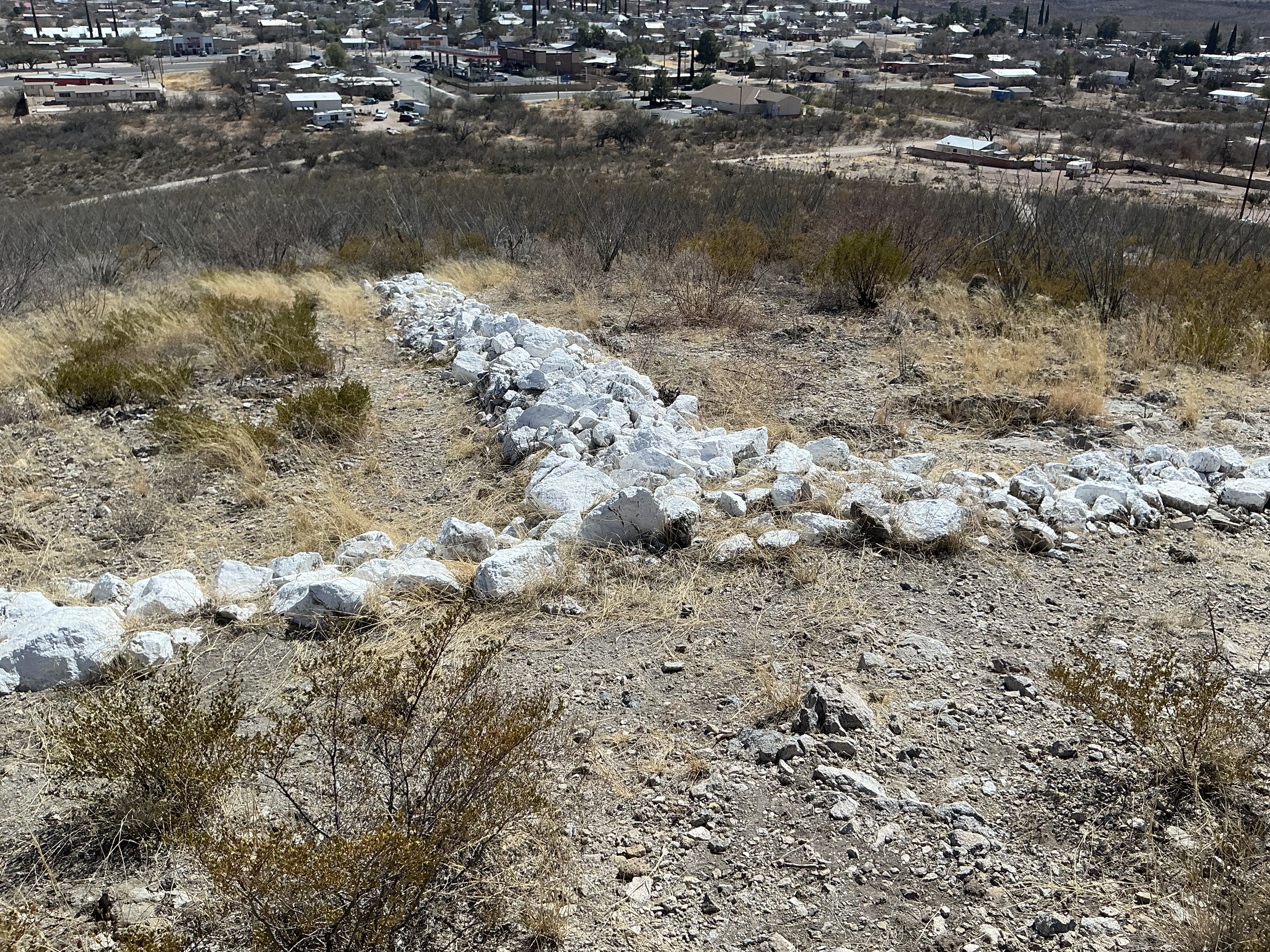
Today, Comstock Hill remains largely undeveloped, with a couple of structures on one slope and a motel at its base. The white-washed "T" is maintained and the trails are tidy. 


Part of the "T" on T-Mountain

One of the old mines. The fence is down nearest the trail - caution!

The "T" on T Mountain, with Tombstone in the background.

The view toward the Dragoons, with a blurry Sheep Head Mountain in sight. The haze is from our constant blowing dust, and not from smog. 

You can pick out many of Tombstone's and surrounding area landmarks from the top of Comstock Hill. Look for the 1881 County Courthouse in the center of Tombstone; the traces of the old Doling Racetrack (where Wyatt Earp once judged horse races!) to the southwest; and old railroad bridges to the west, where ore and minerals were once carried from the mines.  


Tombstone Cemetery (not Boot Hill) as seen from Comstock Hill (T-Mountain). The Tombstone Hills and Huachuca Mountains are in the background. Many of Tombstone's pioneers, including Molly Fly, are buried in this cemetery.


The trail on the southwest side, with the Tombstone Town Cemetery in the background and an arch of ocotillo branches in the front.

The Dragoons in the background with Tombstone High School in the fore.


The T on T Mountain as seen from the base.


At right: The Whetstones to the west, as viewed from the top of T Mountain.


At right: Tombstone Monument Ranch in the far left background, with a barely-discernible Schieffelin Monument to its right.  


My apologies for the weirdly positioned photos, captions, and format of this post! Something glitchy this way comes. I just couldn't get them to cooperate, and for the sake of what little sanity I have left, I am ceding the win to the gremlins within the system. And the photos? I wasn't expecting to hike Comstock Hill that day, fresh from an enchilada breakfast at the Longhorn in town, and didn't have my proper camera with me. Neither did the weather offer me clear blue skies. Sometimes things just don't go as planned - nor get planned.

If you go: For an easy, fast hike with great views of historic Tombstone and the surrounding area, take Safford Street west to Amm Street (it may be unmarked) and park at the base of the trail. Footing is slippery at points due to the loose rocks, but not treacherous. 

Copyright (c) 2025 Marcy J. Miller * All rights reserved * No part of this content, including these crappy photos, may be reproduced without the express permission of the author * Links to this page may be freely shared, and thank you for doing so! * Thanks for stopping by.


Saturday, December 7, 2024

An Ignominious Death for an Old Gunfighter


The grave of Arizona Ranger William "Billy" Old, Pearce, Arizona.

On a quiet patch of flat, dusty earth on the fringes of Pearce, Cochise County, Arizona, I stumbled across a small surprise today. While looking for other graves at the Pearce Cemetery, I noticed one more dignified, elegant tombstone than the rest. It was none other than the gravesite of one William A. "Billy" Old, Arizona Ranger and territorial lawman, whom I'd long forgotten was buried so close to my home.

Born in Titus County, Texas, on July 15, 1870, Billy cowboyed before joining his younger brother, Augie, as a Texas Ranger. When the Texas Rangers downsized, Billy moved to Arizona Territory hoping to join the newly-formed Arizona Rangers. Formed in 1901, the Arizona Rangers didn't hire Billy until August, 1904. Billy served honorably with the Rangers until they were disbanded in 1909. During his time on the force, Billy gained a reputation as being slow to pull the trigger but ever-ready to do so. He, along with his partner Clarence "Chapo" Beaty, were responsible for arresting the desperate rustler Antonio Nunez in December, 1904. In May, they again arrested a horse thief without needing to fire their guns. There was a rumor that after his best friend, fellow Ranger Jeff Kidder, was murdered in Mexico in April, 1908, that Billy Old avenged his death by killing all three of the Mexican nationals involved, but Billy never admitted to doing so. 

Billy married a nineteen-year-old woman named Anna B. Beck in Kelvin, Arizona Territory, on November 6, 1906. Billy named the firstborn of his two sons William Kidder Old in honor of his best friend Jeff Kidder. After the Rangers were disbanded by the Territorial legislature, Billy took a job as a special agent for the Southern Pacific Railroad. As such, he was deputized in the counties he passed through on the job as well as becoming a New Mexico state officer. He thus became the only Arizona Ranger who'd served in all three Territorial law enforcement agencies: Texas, Arizona, and New Mexico. When former Arizona Ranger Captain Harry Wheeler was elected Cochise County Sheriff, Billy took a job as Cochise County Deputy, stationed at the mining town at Pearce. For the most part, Pearce was a quiet camp; Billy Old also worked as the town constable. Anna and their two boys joined him there.  

By then, Billy had a fine reputation as a fearless lawman: after his death, the May 10, 1914 Miami Silver Belt commemorated him as

 "a fearless officer and a fast man with a gun. Weather-beaten in appearance and small in stature, he was big in action. Murderers, highwaymen, horse thieves and cattle thieves on both sides of the international line knew Billy Old. Many of them from Mexico he rounded up on the American side and passed back across the line into the hands of Mexican officers from whom they had escaped. Others whom he captured were sent to the Texas and Arizona state prisons. There was no 'bad man' too bad for Billy Old to go after. To his credit be it said that when he went after a man he brought him in alive. He was not of that brand of gunman whose reputations are gauged by the number of 'notches' on their guns. Quick to draw, he was loath to press the trigger. He would take an extra chance to land his man alive. Face to face with a lawbreaker, he would 'beat him to it' on the draw, but would withhold his fire for the brief time necessary to give a 'covered' opponent a second choice. When Billy Old had the drop, second choices always resulted in surrender on the part of the lawbreaker. And so, in all the years that he rode along the border as an Arizona Ranger - as private, as sergeant, and as lieutenant - though he brought in many notorious 'bad' men, he did his work in this state without putting any notches on his gun." 

One story, told by Ranger Captain Tom Rynning, goes that Billy Old suffered the eternal lawman's complaint of judges releasing criminals as fast as they were brought in. Billy, determining a Justice of the Peace was "in cahoots" with cattle rustlers, allegedly had a "talk" with the judge in a quiet place with plenty of solitude and fresh air. After anchoring the judge to a mesquite scrub by means of a collar and trace chain, he convinced the judge to take the cases more seriously in the future. 

Billy Old also participated when the Rangers famously responded to the Cananea Riot in 1906, as well as the Tiburon Expedition the year before. 

On April 28, 1914, Billy's wife Anna told a friend she was leaving town and leaving Billy - but that she'd kill him first. She packed her things and at high noon, inside their home across from the Renaud Store at Pearce, Anna shot him in the back with a single-action frontier Colt .45. The bullet penetrated his left shoulder, passed through the lungs, and exited his right arm at the shoulder. Anna claimed the shooting was accidental; Billy died within 15 minutes. Although Anna had clearly stated her intent, had assaulted Billy in the past and sent him running for shelter at a neighbor's house, and Billy replied in the negative when asked if the shot had been accidental, Anna was acquitted of the murder during her trial two years later. The coroner's inquest reported that Anna told the men who responded to the incident she'd packed her bags and planned on leaving on the train that afternoon, and was checking to see if her revolver was loaded. She fired but a single shot, leaving five intact rounds in the weapon, and told them, "I didn't know the gun was loaded."

"Against a gun in the hands of a woman, Billy Old had no defense. We do not pretend to know what sense the woman may have had," wrote the Miami Silver Belt. Indeed, Anna had shown signs of insanity prior to the shooting. At one point she dressed as a man and, armed, was confronted by her own husband in his role as Pearce Constable. He narrowly missed shooting her. Those who knew Billy, though, gave her no benefit of doubt. Known for her jealousy as well as her violence, she was neither well-liked nor well-trusted by Billy's friends. 

Anna went on to marry another unsuspecting soul within six months of her acquittal, producing another son. She lived on until 1981 when, at 94, she finally expired. 

The gravestone of William D. Monmonier at the Pearce Cemetery, not far from Billy Old's grave. Monmonier served as the Justice of the Peace and coroner who presided over the inquest into Billy's death at the hands of Anna "Annie" Beck Old.

If you go: Visit the west (historic) corner of Pearce Cemetery. It is isolated and quiet. Make sure you drive around the small town as well; the historic Renaud-Soto General Store is still there, as is the old Pearce Jail. Watch for rattlesnakes! (Serpientes de cascabel!) 


Copyright (c) 2024 Marcy J. Miller * All rights reserved * 

Sunday, November 10, 2024

The Bloody Tragedies at Dragoon Station: The Attack on the Butterfield Employees


 I've got a lengthy Arizona historical bucket list, and one location that has long been on it is Dragoon Station. At long last, I checked it off the list today (although it won't be the last time I visit). Just two miles south of the hamlet of Dragoon, near the site of pioneer Billy Fourr's historically significant Buena Vista Ranch, are the rock wall ruins of what was once a stagecoach swing station on the Butterfield Overland Route. It was here on a moonless night in September, 1858 that a gruesome attack on the Butterfield employees building the stage station near Dragoon Springs occurred. 

The Butterfield construction crew was headed by a young, capable and experienced 24-year-old New York native named Silas St. John. Just a few months prior, St. John had been a ticket agent in Folsom, California, where he spent leisure time acting in local plays. Before that, he'd worked on construction of the first railroad in California. Accompanying  St. John on the construction project in Arizona were James Burr, James Laing, William Cunningham, and three Mexican laborers - Guadalupe and Chino Ramaiva of Sonora, and Bonifacio Miranda of Chihuahua.  

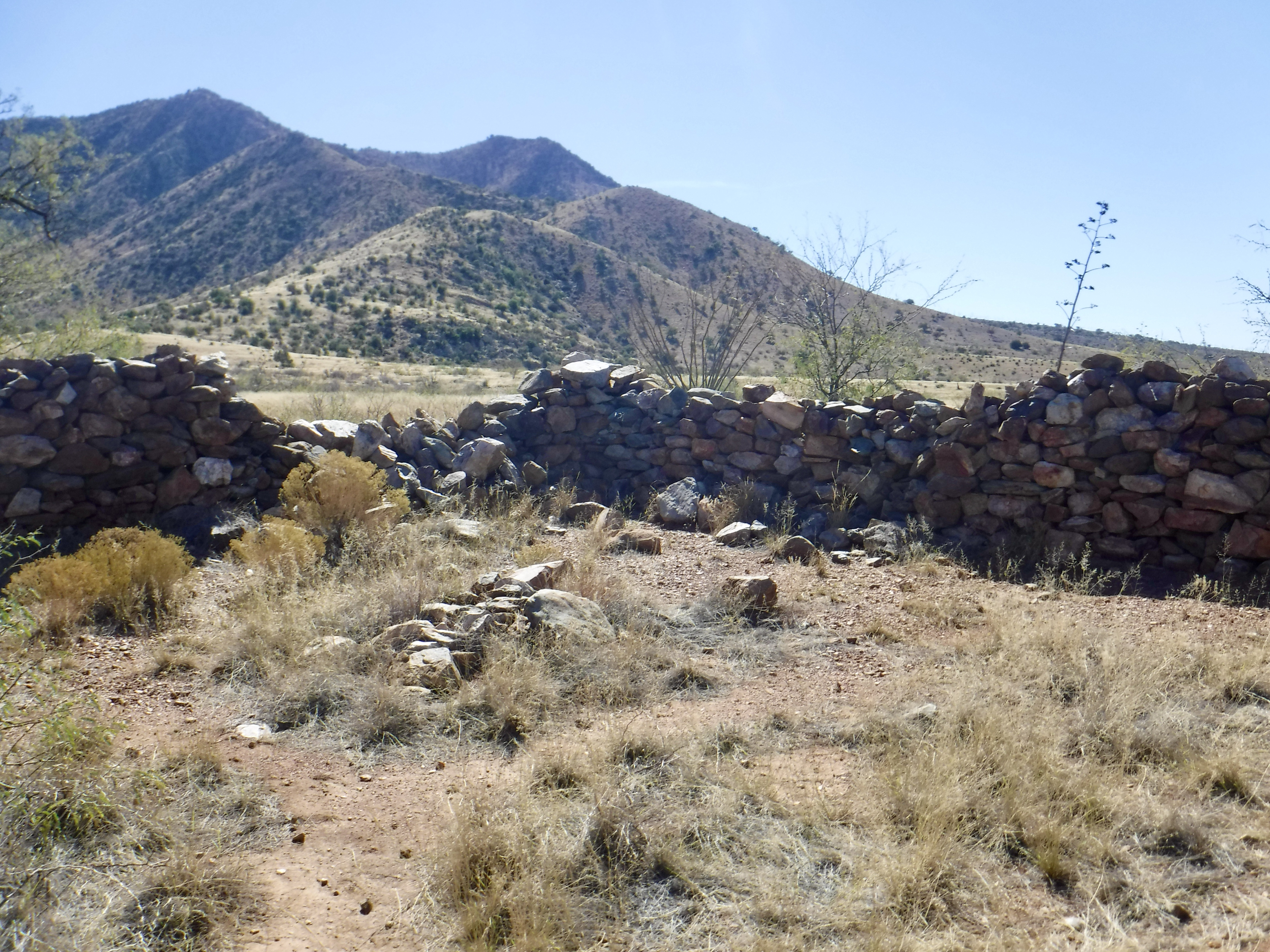
By Wednesday, September 8th, the crew had already formed the 10-foot high walls and the attached stock pen of the station, but had yet to construct a roof. Due to the Apache predations throughout the region, the group assigned lookouts to stand guard throughout the night. At midnight, St. John awakened to change the guard, relieving James Laing with the assignment of Guadalupe who was to stand watch until dawn. James Burr, disliking the sleeping conditions within the rock walls because of the mules sharing the quarters with them, slept outside with the other two Mexican workers. Within the walls were small "rooms" against the east side, still visible today. Laing slept in the center between the two corner rooms; Cunningham occupied the room on the southeast corner; and St. John took the room on the northeast corner nearest the entrance. 


By "room," I'm referring to rudimentary sections of the stacked rock corral no larger than 9 by 10 feet. The livestock corral was attached on the west side. Comfort wasn't an option, but with the cool September weather and the hard physical work the men had been doing, they likely slept well most nights. 


At about one a.m., St. John again awakened, roused by the stirring of the mules and a whistle that was clearly a signal, followed by the sound of blows and the murmured cries of the victims. As St. John got to his feet, he could see the three Mexicans, armed with axes and a stone sledge, confronting him. All three attacked him, aiming for his head: Guadalupe armed with a broad axe, Bonifacio with a sharp-edged chopping axe, and Chino with the dull but heavy stone sledge. St. John fought a hard battle, deflecting one of Bonifacio's first axe blows downward so it missed his head and lodged in his thigh below his right hip. Two more blows, this time from Guadalupe's broad axe, made contact with St. John's hand and arm as he tried to defend himself. As St. John tried to grab his rifle that was leaning against the wall, Guadalupe hit him again, severing the bone of his left arm between the elbow and shoulder. Incredibly, despite his injuries St. John was able to use the Sharps rifle as an impact weapon, swinging it at Guadalupe and knocking the axe from his hands. The Mexicans retreated; St. John was able to get his pistol from the holster on his saddle (which he'd been using as a pillow) and drive them away from the corral. He could not pursue them due to the wound to his hip, but was able to use what was within reach to tie off his wounds and take a defensive position to wait for daylight.

In the darkness, St. John could hear the anguished moans of Laing and Cunningham. As light finally came to the scene on Thursday morning, he could see the horrible wounds inflicted upon the others: Laing, still clinging to life, had suffered a blow from the edged axe to the top of his head that cleft it right down the middle, and St. John could see the man's brains spilling from it. Cunningham's head had three wounds, apparently from the broad axe; he, too, clung to life. Burr, lying outside, was mercifully already dead, his head completely crushed from the stone sledge. Moving had caused St. John's wounds to bleed freely, and he tied off the flow to his arm with his handkerchief and tried to remain still to keep his hip from bleeding out. He could do nothing to assist Laing and Cunningham, nor to tend the thirsty and hungry livestock; neither did he have any water at hand for himself, so he hunkered down and waited and hoped for help to come.

The ruins of the station's walls. The Dragoons are in the background.

The spring that provided water for the station was a half mile of wagon road to the south, and may as well have been miles away. All three men soon suffered horribly with thirst as well as from their severe wounds. The smell of blood drew in wolves (some accounts say coyotes, but wolves are more likely and were a menace in the Chiricahuas throughout the early 20th century), and St. John listened to their yipping in the darkness. 

Cunningham died at midnight on Thursday night. By Friday morning, buzzards and corvids descended upon them, mutilating Burr's face as St. John sat by helplessly. St. John kept the coyotes outside the rock walls by firing pistol shots. The thirsty mules brayed in their own misery, and still Laing lived, now motionless but moaning dreadfully. 

On Saturday night, the coyotes set upon Burr's body, said to be just ten feet from the entrance to the rock structure where St. John and Laing lay. It was not until the next morning help miraculously arrived: a Memphis Avalanche journalist named Archibald and his traveling companion. Headed from Tucson to the Rio Grande, approached on horseback. The station had a flagstaff in the center of the structure, positioned against the dividing wall to the corral, and from a distance Archibald observed the flag was not up. Leery, he waited about a half mile off until deciding to approach on foot while his friend stayed behind with the horses. Gun in hand, he made his way to the station. Shocked and horrified at what he found, Archibald made his way to the spring to get water for the gravely injured St. John, who was now unable to even speak due to thirst, and whose wounds were covered with maggots (which possibly saved his life).

A view of the terrain toward the spring to the south of the station.

As luck would have it, as Archibald headed for the spring, three wagons of soldiers arrived in the area. They, too, waited cautiously nearby when they saw the flag had not been hoisted, and then they, too, crept in carefully on foot. Headed by Colonel James B. Leach, the party included Lt. Sylvester Mowry, Captain Hutton, and others. The soldiers tended St. John's wounds and did what they could (which was not much) for the dying Laing.  They buried the remains of Cunningham and Burr in a single unmarked grave west of the corral. Laing died the next day, on Monday, and apparently shared the same grave.


The party sent two men to Fort Buchanan via Tucson, to collect the post doctor, Dr. B. J. Irwin. They arrived on Wednesday. (Despite a direct route being available, it was not considered a safe route for just the two men due to the Apache threat.) On Friday, Dr. Irwin and his escort arrived at Dragoon - a 115-mile journey. It was now nine days since St. John had been so brutally assaulted. In his report, Dr. Irwin, describing the condition of St. John as he found him on Friday, said he was "weak and pallid from the loss of blood, sleep, and constant  mental and physical suffering; his disposition was cheerful, and he evinced much pleasure at the prospect of having his wounds attended to. A deep, incised wound about eight inches in length, extending from the point of the acromion process, passing inwards, downwards, and backwards, laid open the shoulder point, passed through the external portion of the head of the humerus, and thence downward, splintering the bone through about four inches of its course. The wound in the thigh proved to only be a severe lesion of the soft part about eight inches long and three deep." 

Unsurprisingly, Dr. Irwin deemed it impossible to save the injured arm and there, in that roofless stone corral in that remote setting (which Dr. Irwin himself described as a "rude hovel"), he amputated the arm at the shoulder socket. In his report, Dr. Irwin said St. John "never complained or flinched for a moment; calm and resigned, he bore his torments with the fortitude of a martyr." The "good left arm," as described by St. John, was buried between the other victims of the massacre.

After the surgery, Dr. Irwin and escort transported St. John to the fort, a two day journey covering sixty miles of rough road. The trip caused the ligatures on his thigh to come open, and the doctor said they "protruded" at the site of the amputation. Only on arrival at the fort was the injured man given morphine, a bed, and lodging under a roof. Dr. Irwin described St. John as suffering horrible dreams, phantom pain due to the amputation, and fevers as he convalesced, yet 24 days after the amputation he was walking and within three more weeks he was again traveling, headed back to the east coast. 

St. John's incredible strength, vigor, and determination not only carried him back to his home state of New York, but brought him back to Arizona Territory after his recuperation. The one-armed man served as a Pony Express rider; married; and farmed in Yavapai County. In his later years, both St. John and his wife worked at the Pioneer's Home in Prescott. St. John died in San Diego in 1919 at the age of 84. The three Mexicans who attacked St. John, Laing, Cunningham, and Burr were never brought to justice, having fled across the border. By the account of a Butterfield man named Buckley, who was the nephew of one of the murdered men, the motive for the attacks was robbery of a great deal of valuable goods stored at the corral.


While visiting that bloody site today, I made the short hike to the springs, easily accessible by dirt road. 


This time of year, the sycamore trees are just beginning to color. The spring itself, to the left as you continue south from the station ruins, is currently dry, but the lichens on the rock and the moisture if you scuff the dirt below are evidence of recent moisture. I do not know if the spring still flows seasonally, but judging from the amount of water in the bottom of a nearby mine shaft, I suspect so.

The trail to the spring

It's a beautiful location, as quiet as any you'll find, and even on a Sunday we only encountered two other parties of visitors and an unoccupied truck. Interpretive signs are refreshingly sparse and buildings are far in the distance, allowing you to get a feel for what it was like to be in this remote place at a time when a badly injured man might lie for five days before help might wander up the road.


The low rock wall at right marks the site of the spring.


The moist dirt at center is the spring.

The vertical mineshaft. It's protected by a loose wire fence, but be cautious. 

A rock showing evidence of being used as a grinding stone by native dwellers.

A slag heap of stone removed from the mine shaft. 

If you go: the road back to Dragoon Station is unpaved but doable without 4WD. You'll go through two gates (state land permit required). The site is clearly marked. Unmarked parking is available not far from the site. Watch for snakes, and please respect the site and its history. There are no services in the area, so take water and make sure you're good on fuel. If you continue on to the springs by car, you'll see a small area where you can pull off and park on the right, but you'll still need to hike to the springs themselves (there's no turnaround close to them). The terrain is uneven and rocky but flat, but I made it even with recent injury to my hip and knees. Heck, no way was I going to miss a chance to see it.

Source material for the above narrative includes contemporary news accounts and Dr. Irwin's report; site visit; books and maps. I relied heavily on newspaper reports and paraphrased much of the chronicle, in order, from an account that appeared in multiple newspapers. Direct quotations are indicated by quotation marks.  For an excellent book on the history of the Dragoon Mountains, I recommend Lynn R. Bailey's thorough "Mines, Camps, Ranches, and Characters of the Dragoon Mountains." You can buy a copy here (affiliate link): The Dragoon Mountains 

Look! It's me!

Copyright (c) 2024 by MJ Miller * All rights reserved * No part of this content, including photographs, may be reproduced without the express permission of the author * Links to this page may be freely shared, and are appreciated * Thank you for stopping by!